Monday, 15 April 2013

The Only Question That Matters

The Only Question That Matters...

"Do you love me?"
John 21.16
Gospel for the Third Sunday of Easter : John 21.1-19

We begin the third week of the Easter season meditating on the only question that matters- Do I love Jesus? In this Sunday's Gospel, Peter is asked that very question, but something is definitely "lost in translation". Here is a quick lesson in Biblical Greek...
 Three Words, Three Meanings
There are three words in Greek that translate as the English word, "love". There is eros, which is the fiery, passionate love, that is the energy found in our sexuality. It is the root of the word "erotic". In our passage today, eros is not being used.
The second Greek word for love is phileos, which in English connotes deep friendship and familial love. It root word found in Philadelphia, which is why it is known as the "City of Brotherly Love".
The third Greek word for love is agapeos. The best way to describe it is "sacred love". It is the love that is sacrificial. Jesus described agapeos best "This is my commandment, that you love one another as I have loved you. No one has greater love than this, to lay down one's life for one's friends." (John 15. 12-13)

The distinction is important for understanding the conversation between Jesus and Peter on the beach in John 21.

The Price of Love
We know the story- Jesus asks Peter three times, if he loves him, Peter says yes each time, and Jesus tells him to "Feed my sheep" and "Feed my lambs".
Knowing the Greek makes a HUGE difference. Let's look at this closely.

v.15 ...Jesus said to Simon Peter, "Simon, son of John, do you love (agapeos) me more than these?" He said to him, "Yes Lord; you now I love (phileos) Jesus said to him, "Feed my lambs."
First of all, it is quite telling that Jesus does not call him "Peter" or "Cephas" (The Rock). Is it because of Peter's threefold denial that he perhaps lost his solid status? Is this a re-commissioning? In any event, Jesus is asking him if he truly loves him- if he is willing to give up everything, including his life. In his weakness, Peter can only give him his fidelity and loyalty, but not his life. Jesus, in his loving mercy, accepts Peter for who he is, and commissions him to feed the "lambs"- to care for those most in need. Perhaps it is a call to evangelize, since "lambs" do not really know the shepherd's voice

v.16... a second time he said to him... 
Again, Jesus asks for agapeos, and Peter can only offer phileos. And again, Peter receives a commission, this time to "tend the sheep", a sense here perhaps that he is being asked to care for the Church about to be birthed in the coming age of the Holy Spirit.

v.17 ...He said to him the third time...
When Jesus asks Peter the third time, he no longer uses agapeos. It is a recognition that Peter is simply not ready for what Jesus asks of him. So when "Peter felt hurt because he said to him the third time 'Do you love me?'", it is not because Jesus asks three times, but that he he "came down to his level" by using phileos,  and not agapeos. Peter again responds with phileos, and again Jesus calls him to "Feed my sheep." Jesus then adds that Peter will be taken where he does not wish to go... in his own death, he will come into agapeos.  The "punchline" of the whole scene comes at the very end, when Jesus says to Peter, "Follow me."

Follow me??? Isn't that what Peter and the disciples did for three and a half years? What is curious about John's Gospel is that  Jesus does not invite Peter to follow him until the last chapter! It was his brother Andrew who brings Simon to Jesus, and Jesus names him Peter (John 1.41-42).

Again. John's Gospel invites Peter (and us) to something new. When Jesus says "Follow me" in chapter 21, he is saying:
Follow me, the Risen Son of God! 
Follow me, Jesus the Christ! 
Follow me through death and into Resurrection! 
Follow me into union with the Father, through the the power of the Holy Spirit! 


There is Peter in all of us
Jesus, ever the Good Shepherd, shows his compassion for Peter, while at the same time, never relenting on Divine Love, and the mission.
We, who make up the Body of Christ, are now called into that Divine Love. It is our mission. 
We are called to agapeos.

Can we love Jesus that deeply? IS he the source of our life and love? Or do we offer him phileos, just a part of our love, equal to the love we have for our spouses, our family, our friends, our work, our play, our distractions... ??

There is Peter in all of us.

Yet without agapeos none of our phileos is worthy of who we are called to be.

Agapeos is scary. 

 Because it means complete surrender. Complete emptying of self. It's just too hard. Too impossible.
One Question
Do you love me?
One Response
Follow me.


Monday, 8 April 2013

Peace of Christ

Peace of Christ


"Peace be with you"
John 20.19
Gospel for the second Sunday of Easter:  John 20.19-31
 
Thomas is not the only one.
 

Much has been written and preached about this Easter narrative in John's Gospel, which, over the centuries, has been dubbed "The Doubting Thomas" story.
 
This is a very inaccurate description. Doubt plays a role, certainly, but when it becomes central to the story, it means we are hearing it with our ears, but not with our hearts.
 
Imagine the event...
 
...Jesus came and stood among them and said, 'Peace be with you.'"
It is the evening of the Resurrection. Mary Magdelene has told the disciples that she had seen the Lord. Peter and "the other disciple" had gone to find the tomb empty.
Their testimony was not enough.
 
So, locked in a house for "fear of the Jews", Jesus appears to them. He offers them his peace. The immediate reaction? John doesn't tell us, but we can assume it is still unbelief, because only when he shows them his hands and is side do they "rejoice"!
 
Perhaps we should have called this story, "Thomas and the Doubting Apostles?"


Peace a second time.
It must have been a bit chaotic, because Jesus again says, "Peace be with you."
Once the peace of Christ is given, He gives them the Great Commission (Acts 1.8;Mark 16.15;Matt 28.19) "As the Father has sent me, so I send you." Then there is the marvellous image of Christ breathing on them so they might receive the Holy Spirit (reminds us of God breathing into Adam to give him life in Gen 2.7).
 
Grieving Thomas
 
Jesus then departs (a detail left out of the story) and the focus shifts to Thomas. He "was not with them"- just like those who first heard this account. Remember, John's Gospel is written around 100 AD, and the first witnesses are most likely dead. Thomas represents John's community. Thomas also represents all of us.
 
And this is the point in the story that gets misconstrued. We, in our modern mind, think of Thomas' graphic denial as scepticism.
 
Thomas is not a sceptic. Thomas is in mourning. His grief is so strong that he will not even listen to those who he has journeyed with for three years. Thomas has been witness to the great signs and wonders of Christ.
 
But all that came crashing down on Good Friday. It was too much to bear. And Thomas is in no state to hear HOPE or JOY.
 
Peace a Third Time
 
But he is open to the Peace of Christ. Eight days later, Jesus returns. Specifically, "Jesus came and stood among them and said,'Peace be with you.'" He then offers his hands and side for Thomas to touch ( an offering of his Body), and Thomas offers back his assent, which from that point on, "touches" Thomas and makes him one of the great missionaries and martyrs for the faith. John ends the story with Christ's assurance for the ages: "Blessed are those who have not seen and yet come to believe." (John 20.29)


 For this week....


 There is one message from this Sunday's Gospel that I invite you to consider. When you return to Mass next Sunday, be very awake to the Sign of Peace.

First, note the priest's invocation "The peace of the Lord be with you always.."
So when we offer each other the sign of peace, the intention is not "hey, how are you doing", "have a nice day:" or "glad to meet you". No, we offer each other the peace of Christ. As the Body of Christ, we offer the "peace the world cannot give." The Peace of Christ allows us to follow the Great Commission. The Peace of Christ removes all doubt, anguish and grief. The Peace of Christ heals the world. So when you shake the hand of the person beside you, say "the peace of Christ be with you.."

Second, note where the Sign of Peace occurs.
It is right before Communion
Right before we process as the Body of Christ to become what we receive.
Right before we "touch his hands and side."
Right before we receive him once again.
Right before we say "Amen"- "My Lord and my God".


For next Sunday, be awake to the Sign of Peace. Catholic educators, offer the sign of the Peace of Christ to your students and friends. Bless your families with the Peace of Christ.


Monday, 1 April 2013

Risen!


  RISEN!


Gospel for Easter Sunday: John 20 1-18.

As per usual at our house, we go up to Edmonton for Easter Sunday morning and attend the Divine Liturgy at St. Josaphat's Cathedral in Edmonton. In the clip below, Bishop Moitiuk, the priests and deacons lead the Easter Troparion, which is echoed by the choir and assembly:
The English tradition of the Troparion is:
Christ is risen from the dead,
trampling down death by death,
and upon those in the tombs bestowing life!
This refrain dates back to the first century of Christianity, and is probably the first Christian "hymn". 

After attending the liturgy, I can't help but hum, whistle and sing the chant, well into the rest of the Octave of Easter.

He is Risen!
How do those words resound in our hearts? Are we proclaiming this good news to all our family and friends? What about those of us who educate in and for Catholic schools? Will the first thing we say to our students is "Christ is Risen!" or will it be merely "So how was you holiday?"
++++++++++++++++++++++++++++++++++++++++++++++++++
He is Risen!
The Church is proclaiming something beyond time and space. It is the eternal truth of Jesus' victory over sin and death. And while it has a historical moment in first century Palestine, the Resurrection supersedes history. Pope Benedict XVI has a powerful reflection on the importance of the Resurrection in his book  Jesus of Nazareth Part Two: Holy Week:

...The Christian faith stands or falls with truth of the testimony that Christ is risen from the dead...
      If this were taken away, it would still be possible to piece together from the Christian tradition a series of interesting ideas about God and men, about man's being and his obligations, a kind of religious world view; but the Christian faith itself would be dead. Jesus would be a failed religious leader, who despite his failure remains great and can cause us to reflect,  but he would then remain purely human, and his authority would extend only so far as his message is of interest to us. He would no longer be a criterion; the only criterion left would be our own judgement in selecting from his heritage what strikes us as helpful. In other words, we would be alone. Our own judgement would be  the highest instance.

Only if Jesus is risen has anything really new occurred that changes the world and the situation of mankind. Then he becomes the criterion on which we can rely. For God truly revealed himself. ( pgs 241-242) 


 ++++++++++++++++++++++++++++++++++++++++++++++++

This Easter Sunday, in the Roman Catholic liturgy, the appearance of Jesus to Mary Magdalene was proclaimed. As with all the Resurrection accounts, we have a sense of the closeness and otherness of God. The narrative begins with Mary discovering that the stone of the tomb had been rolled away. Her first reaction is fear- she does not go in, and assumes that even more tragedy has occurred, and there has been something done to the Lord's body. She runs to tell Peter that "they have taken the Lord out of the tomb"- does she mean the Romans? The Pharisees? Gave robbers? 
Next is the race to the tomb of Peter and "the other disciple". Although the disciple gets there first, he too is reluctant to go in. Fear and confusion have also overwhelmed him. It is only Peter, the first always to act or react, that "enters the tomb". Don't miss the significance of the first head of the Church going into the place of the dead. The symbolism of martyrdom should not be overlooked.
Then, a curious line from John- the other disciple went in, saw the empty tomb and the rolled up linens, and believed. The extent of their belief is difficult to determine, but they were not ready to proclaim "for as yet they did not understand the scripture" so they "returned to their homes". (20.9-10)It will be the indwelling of the Holy Spirit at Pentecost that will give them the power to proclaim, and the wisdom to see all that was revealed about Jesus in the Old Testament. For now, we have what is known as a "credal account" of the Resurrection. No need to see Jesus here- an empty tomb is enough.

Mary Magdalene will have an entirely different experience. First, she has an encounter with two angels. They are not proclaimers of the good news. They merely asked her why she was weeping. She repeats a second time " they have taken away my Lord". Then the Lord appears to her, but she did not recognize him. So again she is asked, this time by Christ, "why are you weeping?" He calls her by the generic term "Woman". Again, listen to the language. "Woman" reminds us of Eve in the garden, before the fall. Mary thinks Jesus is the gardener and for the third time believes someone has taken Jesus, and so asks Jesus himself if "he carried him away". 

Jesus then calls her by name.
Mary now recognizes him, and wants to hold on to Jesus, the Jesus that she new as "Teacher". Jesus tells her not to "cling" to the old Jesus. "Do not hold to me, because I have not yet ascended to the Father. The narrative ends with Mary's proclamation of faith "I have seen the Lord!"
++++++++++++++++++++++++++++++++++++++++++++++++++
  

There is so much to unpack in this Resurrection narrative, but I would like us to reflect on the last part. Mary Magdalene and the rest of the disciples wanted to cling to a Jesus that they knew- the Rabbouni, the "Teacher". But Jesus is a new creation, still very much human, but now in complete union with the Father. Once ascended, the disciples will be able to "hold on" to Jesus, now and forever. For now, the disciples are called to proclaim the good news of the Resurrection and our deliverance.
Through his death, Jesus Christ has trampled death by death!
We who are in the tombs of sin are given Resurrection hope!
Through his Church, we can enter into his Paschal Mystery!
Christ is Risen!


For This Week:
For Catholic Educators:  Fill your classrooms and hallways with the Good News! This is a time for flowers, white linens and Resurrection banners. Greet your students with "Christ is Risen!" Spend as much time celebrating Easter in your school as you did preparing for it during Lent!

For All of us: Take time to read the Resurrection accounts in all four Gospels. What similarities are present in the accounts? Which accounts are completely different?


Monday, 25 March 2013


Back to the Garden

"Father if you are willing, remove this cup from me;
yet, not my will but yours be done..." Luke 22.42
Gospels for Passion Sunday:
Entry into Jerusalem: Luke 19.28-40
The Passion: Luke 22.14-23.56

We have now entered Holy Week, the high point of our lives as Christians. This Sunday prepares us for the Triduum - literally, the "three days of feast" that is Holy Thursday, Good Friday, and the Easter Vigil. On Passion Sunday, the assembly gathers in procession, carrying blessed palms and singing songs of praise for the "Son of David, the King of Israel". During the liturgy of the Word, we encounter the Passion of our Lord.

Things are different on this Sunday. We have two Gospel readings. The long narrative of the Passion does not begin with the usual assembly response " Glory to you O Lord" or end with "Praise to you Lord Jesus Christ" Just as Lent has separated us from Ordinary Time, Passion Sunday moves us into something different...
Moves us into the destiny of Jesus
Moves us into our destiny 

I admire any of our homilists who try to sum up the Passion in ten minutes. In former days, no homily was given- only silence. 

Not a bad option! 

So rather than trying to reflect on all of it, I decided to focus on Luke 22.39-46- Jesus in the Garden of Gethsemane, after the Last Supper, and before His arrest.

For a wonderful, comprehensive, and deep reflection on this, and the whole  Paschal Mystery, read Pope Benedict XVI's  Jesus of Nazareth Part Two: Holy Week from the Entrance into Jerusalem to the Resurrection (San Francisco: Ignatius Press, 2011.) 
Back to the Garden.....
++++++++++++++++++++++++++++++++++++++++++++++++++++++++++++++++++++++++
Flashback to the 60's...
 Do you remember the song Woodstock by Joni Mitchell (made famous by Crosby, Stills, Nash and Young)? The chorus was profound, especially the last refrain,  although I don't think Joni was writing about Christ's Passion:

We are stardust, 
(Billion year old carbon)
we are golden
(Caught up in the Devil's bargain)
And we've got to get ourselves back to the garden... 

Of course, this song was written in the height of the peace and love of the 1960's, celebrating the Woodstock nation "half a million strong" Going "back to the garden" implied that we need to regain the innocence that was Eden, and somehow, the Woodstock music festival was a symbol for the return to innocence. And the "Devil's bargain"? I guess anyone who "sold out" to the "establishment", and got caught up in the Vietnam war, constrictive social norms, older generation hang-ups etc. This was a very groovy song, man.
I listen it to it differently now...
++++++++++++++++++++++++++++++++++++++++++++++++
All four Gospels proclaim the Garden

 After the Last Supper, Jesus went to an isolated place to pray:
Mark and Matthew:  They went to a place called Gethsemane ("Gethsemane" refers to a place where olives are crushed to make oil)
 Luke: He came out and went, as was his custom, to the Mount of Olives, and the disciples followed him
John:... he went out with his disciples across the Kidron valley to a place where there was a garden, which he and his disciples entered .

 We see then, that our tradition brings the four Gospel account together, and we remember Jesus' agony in the Garden of Gethsemane, even though John's Gospel is the only one that describes a garden. As the Gospel of John was written around the year 100, a certain depth of theology is found there.
The image of the Garden, and Jesus' prayer to the Father are critical to our understanding of who we  are as disciples....
++++++++++++++++++++++++++++++++++++++++++++++++
 It all began in the Garden
 As in Joni Mitchell's song, the use of the term "garden" in John's Gospel triggers the image of the beginning of time, and the Garden of Eden. 

We are reminded of our first parents, who made the decision to disobey the Father in order to become gods themselves. The fall, our fall, is the temptation for humanity to become divine without the Divine Godhead.

And now the Son, both truly God and truly Man, enters the Garden for our fallen sake. He cries out in anguish of the horror that is our sin, as he would take on the shame of our sins, only to suffer and die for our sake. 
For the sake of our own destiny. 
He died and rose that we might live. 
The Good Shepherd leads his flock through the valley of death
 to the pastures of the Heavenly Kingdom 
The "new Adam" (as St. Paul calls Christ) through total obedience to the Father, makes up for the disobedience of the "old Adam".
++++++++++++++++++++++++++++++++++++++++++++++++++
Why are you sleeping???
In Luke's version of Gethsemane, Jesus speaks three times:
"Pray that you may not come into the time of trial" (Luke 22.40)
"Father, if you are willing, remove this cup from me; 
yet, not my will, but yours (Luke 22.42)
"Why are you sleeping? Get up and pray that 
you may not come into the time of trial ."
Notice that, like every moment of Jesus' life, prayer is at the heart of who He is. His own prayer of supplication and obedience his bracketed by his plea to the disciples to pray for vigilance in prayer.  This is his prayer for us!! We are constantly sleeping, even though we are awake!

As Pope Benedict XVI notes in his Jesus of Nazareth:

"Across the centuries, it is the drowsiness of the disciples that opens up the possibilities for the power of the Evil One. Such drowsiness deadens the soul, so that it remains undisturbed by the power of the Evil One at work in the world by all the injustice and suffering ravaging the earth. In its state of numbness, the soul prefers not to see all of this; it is easily persuaded that things cannot be so bad, so as to continue in the self-satisfaction of its own existence. Yet this deadening of souls, the lack of vigilance regarding both God's closeness and the looming forces of darkness, is what gives the Evil One power in the world... (pg 153) 
 ++++++++++++++++++++++++++++++++++++++++++++++++
Love's New Name...
 I once heard Fr. Ron Rohlheiser talk about Gethsemane and the importance of the garden.
"Gardens", Father Ron said, "are places where lovers meet."

Love, now met through the anguished tears "as of drops of blood", has a new name.

No longer just "eros" - the passion of lovers and the energy that drives all creation;

No longer just "filoque" - the love of sons and daughters, fathers, mothers, and friends

Love's new name is "agape": the self-sacrificial love, the love of one not served, but one called to serve.

But...

 Love's new name will be even greater than agape.

Love's new name is...


Monday, 18 March 2013

Breaking Free

Breaking Free

"Unbind him and let him go." John 11.44
Gospel of the Fifth Sunday of Lent (Third Scrutiny)John 11.1-45
I had the good fortune to be by a television on Wednesday when "Habemus Papem!" was announced.

It was quite an emotional moment. Thunderous applause and cheering from the people gathered in St. Peter's Square, followed by a confused hushed when the prefect continued:
Eminentissimum ac Reverendissimum Dominum,
Dominum Georgium Marium
Sanctae Romanae Ecclesiae Cardinalem Bergoglio
qui sibi nomen imposuit Franciscum 

Who? Who is Cardinal Bergoglio? He was not one of the front-runners! 

Then the cheering grew when it became apparent that the Holy Spirit had directed the College of Cardinals to do what the Holy Spirit always does- surprise us! And what a surprise- a South American of Italian descent, 77 years old, a Jesuit who chooses the name Francis...

And whose first words as Pope were "Brothers and Sisters, good evening!"

We are so foolish! Why are we so bound by our preconceived notions of what the Church should do, or who our Shepherd should be? Can we not be free to trust in the Holy Spirit who always guides the Church, even in times of struggle and darkness?

Binding and freedom 
are two themes found in this past Sunday's Gospel. I chose the Gospel of the Third Scrutiny, although the other Gospel (John 8 1-11, the story of the adulterous woman) has those themes as well. 

John 11.1-45 begins with the news that Lazarus, a close friend of Jesus, had taken seriously ill. Jesus decides to wait until Lazarus has been dead for three days ( note the symbol) until he decides to go to Bethany in Judea. At this point the disciples, with their preconceived notions of Jesus, assumed that he would have gone to see his friend sooner to cure him. Some must have thought that Jesus delayed because he was afraid of going to Judea.

Jesus tries to unbind their thinking. He was going to raise Lazarus as a sign of the  Father's glory,  not because Lazarus was a personal friend.

And he would do it at the risk of his own persecution.

As the story continues, it is clear that Martha, Mary and the onlookers were bound by their expectations of Jesus. "Where was he? He could have saved him."
Jesus weeps.
 Usually the explanation for the weeping Jesus is that he is showing his humanity for the loss of a friend. I think that is only part of it. Perhaps Jesus also weeps in frustration that, after so many signs and wonders, the people need to see someone raised from the dead. And even after that, there will be rejection of the Son of God. John may also be reflecting Jesus' agony in the garden, which is not detailed in his account of the Passion but placed here in the context of the death and resuscitation of Lazarus.

The Call
 Jesus, as He always did, prays to the Father before acting. His prayer, directed to the Father, asks that His will be done, not for Lazarus, and not even for Jesus. Jesus asks that the will of the Father be done "for the sake of the crowd standing here, so that they may believe that you sent me (John 11.42).

Jesus then says two things:
First, to Lazarus: "Come out!"
Secondly, to the crowd: "Unbind him and let him go free!"

The sign of the raising of Lazarus, is not about a special privilege of a close friend that Jesus had in Bethany. This is about the special privilege we have of hearing the call of Jesus. In order to hear that (loud) call, we need to be unbound, free of our sinfulness, and our preconceptions, biases and prejudices. We need to be set free of our egos. And we need to trust in the Holy Spirit who continues to pour out the graces we received in Baptism and Confirmation. We will be set free through our participation in the sacraments of Reconciliation and Eucharist.

As we enter a new moment in the life of the Church, let us be open to the light of the Holy Spirit, who brings us ever closer to the Father through our life in Christ Jesus.

For this week...

If you are work in a Catholic school...
Many of the Catholic school districts will be having march break during Holy Week, so this will be the last week before the glorious Triduum. Make sure you take the time with your students to explore a few of the many beautiful signs and symbols around Holy Thursday, Good Friday and Holy Saturday. If you are getting ready to welcome new members into the Church, get to know them. Have your students write cards of encouragement as the elect and the candidates begin their new lives in Christ.

For all of us...
  • Ask the Holy Spirit to keep you open to the Father's will. 
  • Get to know Pope Francis, not from the secular media, but through his own words. Read his first homilies and speeches on the Vatican web site:http://www.vatican.va/phome_en.htm 
Blessings and Peace
Michael
 

Monday, 11 March 2013

God Comes Running...

"...But while he was far off, his father saw him and was filled with compassion; he ran and put his arms around him and kissed him..." Luke 15.20

Gospel for the 4th Sunday of Lent: Luke 15.1-3, 11-32 (http://www.catholic.org/bible/book.php?id=49&bible_chapter=15)
 
Growing up in Brampton Ontario in the 60's, there were limited options for parents who wanted to send their kids to a Catholic school. For the Marien boys, it meant a trek of a couple of miles from the newly developed suburb to St. Mary's elementary, closer to the downtown. The trek was not uphill both ways, we had shoes in the dead of winter, and we were never attacked by wild animals. For little kids, it was long, but never a hardship.

One fall day, there was a little bit of a communication mix-up. My two older brothers had, for reasons that escape me, left their six year old brother at the school. After waiting around for a half an hour, I decided to start heading back home by myself. I knew the way, and from my six-year old perspective, didn't think much of what lay ahead. I was simply miffed at my brothers. 

About twenty minutes down the road, I see Mom running (!) towards me. With tears in her eyes she hugged me tight and kissed me. I still wasn't sure what the big deal was about, but I was glad that Mom was with me for the rest of the way. It was only later that I realized that she must have run at least a mile and half to get to me so quickly. As for my brothers, well, they never forgot me at the school again!

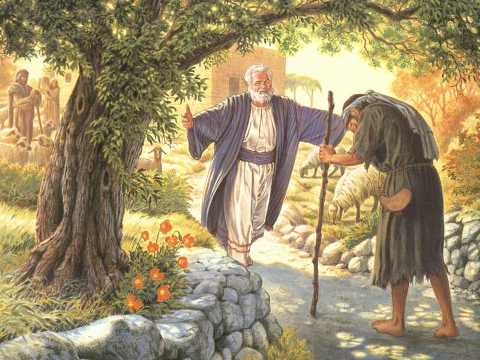
The parable of the Prodigal Son and the Forgiving Father reminded me of my little adventure. Take a look at the image at the top of the page once again. When you Google images of the Prodigal Son, you will find many of father and son in embrace, but this was the only one that I could find which shows the father running to the son. I'll come back to this image, but first, some reflections on the parable. Remember that Jesus' parables are not merely stories, or symbolic riddles to "figure out". They are multilevel narratives that will reveal many meanings to us when we are open to receiving them. Here are some meanings around the characters for you to consider:

The prodigal, at one level, are the ones such as the sinners who Jesus associates with in Luke's Gospel. The Pharisees condemn Jesus for his table-fellowship with tax collectors and prostitutes. Jesus is reminding the Pharisees that these sinners are on the path to conversion, and are going back to the Father. After squandering all that Father has given them, they recognize their sinfulness and look for mercy. 
As always, we see ourselves as the prodigal, when we open ourselves to God's mercy and ask for forgiveness of our sins.

The older brother are the Pharisees, and the whole of Israel, who cannot stand the fact that Father would love sinners that much. In a sense, they condemn themselves by "refusing to go in" to the banquet (15.28). The older is angry, and we start to wonder just how much he really loves the Father at all. Notice when the older brother says "Listen, I have working like a slave for you, and I have never disobeyed your command, yet you never given me even a young goat so that I might celebrate with my friends. (15.29-30). He doesn't want to celebrate with his Father?? He sees himself as a slave?? 
We see ourselves  as the older brother, whenever we become self-righteous, whenever we feel that God "owes us", and whenever we harbor ill feelings and jealousy towards our neighbor.
And, the true central character of the piece... 
The forgiving father, who, after being completely wounded by the prodigal runs to greet him, and not only forgives, but celebrates with all the riches he has to offer. For Jesus' audience, and for most of us, this is sheer madness! What, no punishment? At least give the boy what he expects! Make him a slave so he can "pay back"!
Jesus reveals the truly unbelievable mercy  of the Father, a Father who rejoices when the son comes back...
Back from the dead. The parable now has a powerful new twist. Jesus is the prodigal, although without sin, suffers and dies for the sins of the many. And now he "celebrates" with the Father, and is "seated at His right hand". 
Do we see ourselves as the forgiving father? Do we show the mercy and forgiveness that our Father has for us? After all, isn't that the core petition of our greatest prayer- "forgive us our trespasses as we forgive those who trespass against us..."???

Read and pray over this parable again.
 Remember that when we turn back to God, God will come running like a loving father. 

Or mother :) 
  
For this week
For Catholic educators "on the School Bus to Emmaus"
Talk about the discipline policy in your school with your colleagues, and talk about it with your students. Does the discipline your school and your classroom reflect the mercy of the forgiving Father?
For all of us
Pray the "Our Father" slowly and carefully. Pause when you reach the part about forgiveness. Ask Jesus to help you forgive those who have wounded you. Reconcile yourself with them.


Sunday, 3 March 2013

Second Chances

" A man had a fig tree planted in his vineyard..."
Luke 13.6-9
Second Chances
 Gospel for the Third Sunday of Lent: Luke 13. 1-9
As the husband of a very serious and avid gardener, this time of year is filled with anticipation, excitement, and occasionally, frustration. You see, our sun room is now a nursery, slowly filling up with germinated seedlings and transplants. I love going in and smelling the soil and seed - a preview of spring.
It can be, as I said, a little frustrating, especially when you do the exact same thing as you did last year, but instead of 70, 80 or 90% germination, you can get zero. Is the seed? The soil? A temperature change? Bacteria? Whatever the case, if you want those petunias, you have to start all over again, and try to eliminate the unknown factor.
 
This is why I generally stay clear of this part of the production- I'm all for taking the plants and putting them in the ground. But germinating and transplanting? Everything is just too tiny and delicate! 
 
From the many years we've done this, I have to say that I very much admire Shirley's patience and tenderness. It actually saddens her when seedlings die...
 
In today's Gospel we hear the parable of the Barren Fig Tree, which expresses the patience, tenderness and mercy of the Father through the salvific actions of the Son. 
 
First, Jesus sets up the parable by revealing to the crowds the misguided notions they had concerning God's judgement. He talked to them about the recent slaying of some Galileans at the hands of the Romans. The Jewish mindset at the time was that they must have been most sinful to have to undergo such a horrible death. Not so, says Jesus. In fact, 'unless you repent, you will all perish as they did." Jesus of course was not referring to their physical death, but to the death of their eternal joy with God. Jesus was turning their whole notion of God's judgement upside down.

He then tells the story of the Barren Fig Tree. The details in this parable, like all the parables, are worth exploring. 
 
First of all, a man plants a fig tree in his vineyard. Why the vineyard? Obviously not for profit, but for the sheer pleasure of enjoying the tree and its fruit. So it is with God, who created us not for any other purpose than for the sheer love of being in relationship with Him. No hidden agendas. Just love.

Then, he came looking for fruit on it and found none.. Does this remind us of a time when God "went looking in the garden" and could not find Adam and Eve?

And so he speaks to the gardener and says he has been looking  for three years and their is no fruit. Time to cut it down. "Three years" is the time it actually takes for a fig tree to bear fruit, but "three" is also an eternal number. We see here a connection between the fig tree and the whole history of Israel, the nation who would turn away from God, and return to Him over and over again...

The gardener then speaks up. "Let it alone for one more year. If it bears fruit, well and good, if not, cut it down." The gardener, Jesus, offers himself for the sake of the tree. It is our second chance. The owner relents.

The parable's "punchline" (they all have them) is about the bearing of fruit. You see, Jesus wants to make the point with us that it's all about the way you live your life that's important. Too many times we think we're all OK with God because, after all, we haven't killed anybody, or broken the other 9 commandments. So come on! We haven't done anything wrong...
 
The fact remains- have we done anything right? Right with God and our neighbor? Have we done anything to help the poor and oppressed? Have we done anything to bring the Reign of God closer to the full glory of justice and peace?
Have we bore any fruit?
For this week:
 
For those of us who are educators, take time with your students and colleagues to make a plan to hep the poor and oppressed. Work on projects that are mlore than just cash donation drives.
 
For those of us who are Catholic in the Archdiocese of Edmonton: This Wednesday March 6th, every priest in the diocese is available to hear Confessions all day, and into the early evening. His Grace has asked us to take advantage of this day of Reconciliation, to celebrate the Church's Year of Faith, and the Archdiocese's 100th anniversary.
Make every effort to receive reconciliation on March 6th. Your spiritual life will bear much fruit.